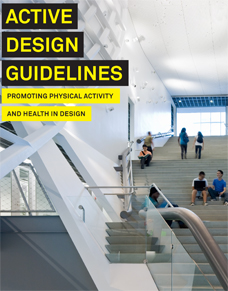
"A primer on Active Design, which creates buildings and environments that fight America’s obesity epidemic.
Today, obesity is poised to overtake tobacco as the leading preventable cause of death in America. More than a third of all Americans are obese and an additional third, overweight. Total U.S. health care costs attributable to obesity are expected reach $860 to $960 billion by 2030.
For years, health advocates have been wagging their fingers, telling us to eat more healthy foods and exercise more. But it’s not working. Obesity is a public health
epidemic and it’s a lifestyle that’s hard to change. As a recent
New York Times headline stated “
Told to Eat Its Vegetables, America Orders Fries.” We need a public health strategy beyond finger wagging, and the solution just might be design.
We need a public health strategy beyond finger wagging
Active Design
Active Design can be seen in the
guidelines recently released by New York City, which addresses obesity and obesity-related diseases by encouraging physical activity through the design of our environment.
Active Design is the idea that we can design cities and buildings to encourage people to get more exercise. This is not about encouraging us to go to the gym and working out more, but instead, it's about giving citizens more of a workout through how we interact with our environment on a daily basis. This could include
walking instead of driving, taking stairs instead of elevators, and creating parks and other interesting engaging environments to walk through. By attacking obesity through urban design and architecture, governments are beginning to realize that designers might be their best warriors in the battle against obesity and its costs.
A New Strategy
New York City’s Active Design Guidelines may represent the beginning of a strategic shift in the battle to get Americans to exercise. Instead of trying to change individual choices by using a moral appeal about what is good for us (you should walk to work because it is better for you), it’s about changing the environment to reshape the available choices (you’ll want to walk because it is easier, cheaper, faster, or more enjoyable).
This strategy recognizes that the public’s underlying motivations are not about health, but rather, about what is convenient and enjoyable.
Walkability
How do you make an environment that makes it so people are more likely to walk? Picture a place you would like to take a walk in; now picture one you would hate to walk in. It’s pretty easy to see the difference.
The website
WalkScore has attempted to quantify walkability by rating any individual address based on how many basic needs and desires can be met within a walkable distance. This excellent tool, which has become popular in the real estate world, does a great job as far as things that can be quantified. It can tell you if there is a grocery store within walking distance, but it can’t tell you what the quality of that walk to the store is like. How busy is the street? Are there sidewalks? Are there trees for shade?
Studies have shown that walkable places have a clear sense of definition or enclosure, are identifiable and memorable, relate to human scale, and have a sense of activity, complexity and visual richness—in short, an environment that feels stimulating and safe.
Environments that are unwalkable are boring, feel vast and scaleless, and present blank unvaried views. Contrast a vast parking lot with a lively café-lined street and it’s clear what makes an environment walkable.
Stimulating the Imagination
Variety and stimulation is especially important for the young digerati who have grown up in a wired world that brings a universe of entertainment and social interaction to them through a screen and a keyboard.
To motivate the under-25 crowd to use their legs—instead of their thumbs—to explore the world, the real world must compete with the digital one in terms of stimulation. Dense, multi-use urban environments with a variety of offerings can provide the stimulating surroundings that encourage walking and real-life social interaction.
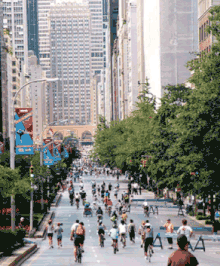
Biking is another front for Active Design. Building bike trails, bike lanes, and bike racks provide the basic infrastructure, and cities across the country are putting renewed effort into such programs. Washington, D.C., and San Francisco have initiated bike sharing programs. In New York, a 2009 zoning amendment requires that all new buildings over a certain size provide bike storage.
Stairs
Architects have long had a love affair with stairs—from the elegant curves of Garnier’s Opera in Paris to the sleek floating glass of Apple stores. But the stairs in most multi-story buildings today are largely functional, emergency-use only environments which take a back seat to elevators for moving people between floors.
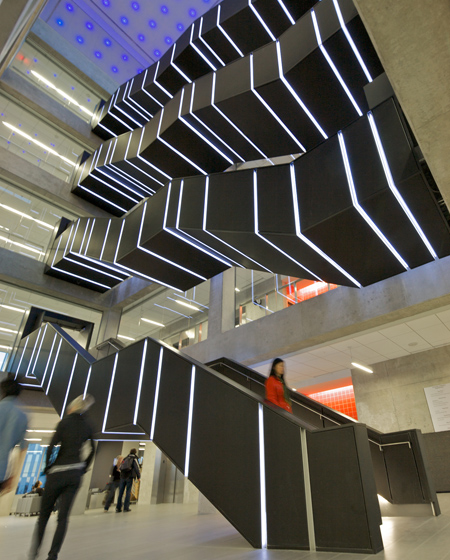
Active Design celebrates the stair, encouraging designers to make them visible, accessible, and integrated into a building’s primary circulation and orientation. By making stairs enjoyable, and giving them precedence over elevators or escalators, more people will use them. A
1997 study showed that men who climb 20-34 flights of stairs per week have a 20% lower risk of stroke or death from other cardiovascular causes.
[The Engineering Five Building at the University of Waterloo, by Perkins+Will]
An Urban Renaissance
A century ago cities were seen as unhealthy environments—dirty and disease-ridden. But today it is the active urban lifestyle that is proving to be the healthiest model.
If we design all our living environments to be more like stimulating, engaging, and diverse cities, then people will live longer, healthier lives. A 2004 study in Atlanta showed that men in more suburban, purely residential neighborhoods were on average 10 pounds heavier than the same demographic who lived in more urban, mixed-use areas.
Active Design might signal a strategic shift.
And
New Yorkers have an average life expectancy
1.5 years longer than the rest of the country. At least part of that is attributable to New Yorkers walking more. And they walk because their environment is designed to encourage them to.
Conclusion
For now, Active Design is just a set of guidelines, not a ban on laziness. And although it has begun to influence building codes and zoning laws, Active Design currently has no real legal bite. Many of the smoking bans of the 1990s were enacted because companies and institutions feared that they would be sued over second hand smoke.
Second-hand obesity has yet to be recognized as a problem, and lawsuits against building owners for not making stairways more attractive are unlikely. But the principle of attacking a public health problem through changes to our environment—using design to change our lifestyle choices and using motivations other than doing it for our own good—is a compelling one.
Active Design isn’t a silver bullet to end obesity. But it just might signal a strategic shift that could help turn the obesity tide.
As both an urban designer and an architect, Jack L. Robbins brings a design-oriented approach and international perspective to solving complex urban design problems. Robbins has worked for nearly 20 years with public and private clients around the world, designing large scale master plans, campus plans and development frameworks, as well as residential and commercial high-rise buildings.
Fonte e imagens:
http://www.fastcodesign.com/1663272/this-is-why-you-re-fat