Mostrar mensagens com a etiqueta Desenho urbano. Mostrar todas as mensagens

How do bike-sharing schemes shape cities?

"NEXT month a so-called "brand new means of transport" will be launched in Copenhagen: the bicycle. GoBike, Europe's latest bike-sharing scheme, will have bicycles with built-in tablet computers that direct cyclists to the best local restaurants, show offers in nearby shops and give the latest train times. Bike-sharing is shifting up a gear: it seems that nearly every self-respecting mayor is either developing a scheme or announcing an expansion to one. What is the impact on cities' development?
Bike-sharing began in the 1960s when 50 "free bikes" were scattered around Amsterdam. They were promptly stolen. But after this slow start bike-sharing has blossomed. Over the past decade the number of schemes has increased tenfold. Bike-sharing ventures now exist in more than 500 cities, from Dubai to Hawaii. Each works on the simple principle that a user can borrow a bike at a docking station and then return it to another. The first 30 minutes are usually free. The most successful schemes have large fleets of bikes, lots of small docking stations and a few "superdocks" in busy places, such as train stations. Electronic monitoring of the bikes can show ebbs and flows of bike traffic through cities, allowing better distribution of bikes and planning of new docks.
Just as mass public transport changed the development of cities' suburbs, bike-hire schemes are now shaping city centres in subtle ways. A "cycling census" in London found that in the morning rush-hours nearly half of all northbound traffic crossing three of the city's main bridges was made up of cyclists. Planners have responded by criss-crossing the city with cycle-paths; more are proposed. Some mayors are experimenting with bike-only days: Mexico City, the unlikely home of a highly popular bike-hire scheme, closes its central eight-lane highway to cars every Sunday, to the rage of motorists. Property developers are taking note, too: just as houses near metro stations tend to command higher prices, research now suggests that access to cycle paths and proximity to docking points is linked to higher rents. Finally, bike-sharing opens up parts of cities that were previously hard to access by public transport, especially late at night when bus and train services get thinner. Research by Susan Shaheen at the University of California, Berkeley, found that in Montreal and Toronto four out of ten people shopped more at locations near bike stations. In Washington, DC, more than eight out of ten said they were more likely to visit a business, shop or restaurant with easy access to bike-sharing dock.
Just as researchers begin to grasp the impact of bike-sharing, the schemes themselves continue to evolve at speed. New developments include much cheaper "dockless" bikes, already in use in Berlin, which can be found by mobile phone. Another promising development is the introduction of electric bikes, for longer or steeper journeys. Such innovations could help broaden the appeal of bike-share schemes beyond their current users, who are mainly young, relatively well-off men. Bike sharing is just one part of a broader movement towards alternative forms of transport in increasingly crowded cities, but it could be an important one. As last year’s United States Conference of Mayors concluded: "communities that have invested in pedestrian and bicycle projects have benefited from improved quality of life, healthier population, greater local real-estate values, more local travel choices, and reduced air pollution." Time for more of the world to go Dutch."

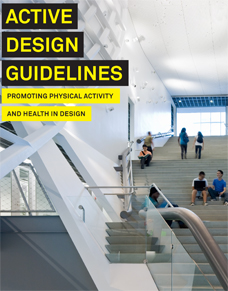
ACTIVE DESIGN GUIDELINES

 
In the 19th and early 20th centuries, architects and urban reformers helped to defeat infectious diseases like cholera and tuberculosis by designing better buildings, streets, neighborhoods, clean water systems, and parks. In the 21st century, designers can again play a crucial role in combating the most rapidly growing public health epidemics of our time: obesity and its impact on related chronic diseases such as diabetes, heart disease, and some cancers. Today, physical inactivity and unhealthy diet are second only to tobacco as the main causes of premature death in the United States. A growing body of research suggests that evidence-based architectural and urban design strategies can increase regular physical activity and healthy eating.
The Active Design Guidelines provides architects and urban designers with a manual of strategies for creating healthier buildings, streets, and urban spaces, based on the latest academic research and best practices in the field. The Guidelines includes:
Urban design strategies for creating neighborhoods, streets, and outdoor spaces that encourage walking, bicycling, and active transportation and recreation.

Building design strategies for promoting active living where we work and live and play—for example, through the placement and design of stairs, elevators, and indoor and outdoor spaces.

Discussion of synergies between active design and sustainable design initiatives such as LEED and PlaNYC.
 
 
  The Active Design Guidelines was developed by a partnership of the New York City departments of Design and Construction, Health and Mental Hygiene, Transportation, City Planning, and Office of Management and Budget, working with leading architectural and planning academics, and with help from the American Institute of Architects New York Chapter. Other City agencies that have contributed to the Guidelines includes the Mayor’s Office for People with Disabilities, Mayor’s Office of Long-Term Planning and Sustainability, Department of Buildings, Department of Parks and Recreation, School Construction Authority, Housing Preservation and Development, and the Department for the Aging.
   
 
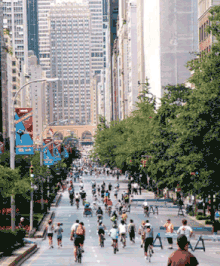
Image: Summer Streets, Park Avenue


Fonte e imagens: http://www.nyc.gov/html/ddc/html/design/active_design.shtml

A New Design Movement That Can Help Us Beat Obesity

"A primer on Active Design, which creates buildings and environments that fight America’s obesity epidemic.
Today, obesity is poised to overtake tobacco as the leading preventable cause of death in America. More than a third of all Americans are obese and an additional third, overweight. Total U.S. health care costs attributable to obesity are expected reach $860 to $960 billion by 2030.
For years, health advocates have been wagging their fingers, telling us to eat more healthy foods and exercise more. But it’s not working. Obesity is a public health epidemic and it’s a lifestyle that’s hard to change. As a recent New York Times headline stated “Told to Eat Its Vegetables, America Orders Fries.” We need a public health strategy beyond finger wagging, and the solution just might be design.
We need a public health strategy beyond finger wagging

Active Design

Active Design can be seen in the guidelines recently released by New York City, which addresses obesity and obesity-related diseases by encouraging physical activity through the design of our environment.
Active Design is the idea that we can design cities and buildings to encourage people to get more exercise. This is not about encouraging us to go to the gym and working out more, but instead, it's about giving citizens more of a workout through how we interact with our environment on a daily basis. This could include walking instead of driving, taking stairs instead of elevators, and creating parks and other interesting engaging environments to walk through. By attacking obesity through urban design and architecture, governments are beginning to realize that designers might be their best warriors in the battle against obesity and its costs.

A New Strategy

New York City’s Active Design Guidelines may represent the beginning of a strategic shift in the battle to get Americans to exercise. Instead of trying to change individual choices by using a moral appeal about what is good for us (you should walk to work because it is better for you), it’s about changing the environment to reshape the available choices (you’ll want to walk because it is easier, cheaper, faster, or more enjoyable).
This strategy recognizes that the public’s underlying motivations are not about health, but rather, about what is convenient and enjoyable.
walking-Jesslee-Cuizon

Walkability

How do you make an environment that makes it so people are more likely to walk? Picture a place you would like to take a walk in; now picture one you would hate to walk in. It’s pretty easy to see the difference.
The website WalkScore has attempted to quantify walkability by rating any individual address based on how many basic needs and desires can be met within a walkable distance. This excellent tool, which has become popular in the real estate world, does a great job as far as things that can be quantified. It can tell you if there is a grocery store within walking distance, but it can’t tell you what the quality of that walk to the store is like. How busy is the street? Are there sidewalks? Are there trees for shade?
Studies have shown that walkable places have a clear sense of definition or enclosure, are identifiable and memorable, relate to human scale, and have a sense of activity, complexity and visual richness—in short, an environment that feels stimulating and safe.
Environments that are unwalkable are boring, feel vast and scaleless, and present blank unvaried views. Contrast a vast parking lot with a lively café-lined street and it’s clear what makes an environment walkable.

Stimulating the Imagination

Variety and stimulation is especially important for the young digerati who have grown up in a wired world that brings a universe of entertainment and social interaction to them through a screen and a keyboard.
To motivate the under-25 crowd to use their legs—instead of their thumbs—to explore the world, the real world must compete with the digital one in terms of stimulation. Dense, multi-use urban environments with a variety of offerings can provide the stimulating surroundings that encourage walking and real-life social interaction.
Biking-Nicki-Varkevisser
Biking is another front for Active Design. Building bike trails, bike lanes, and bike racks provide the basic infrastructure, and cities across the country are putting renewed effort into such programs. Washington, D.C., and San Francisco have initiated bike sharing programs. In New York, a 2009 zoning amendment requires that all new buildings over a certain size provide bike storage.

Stairs

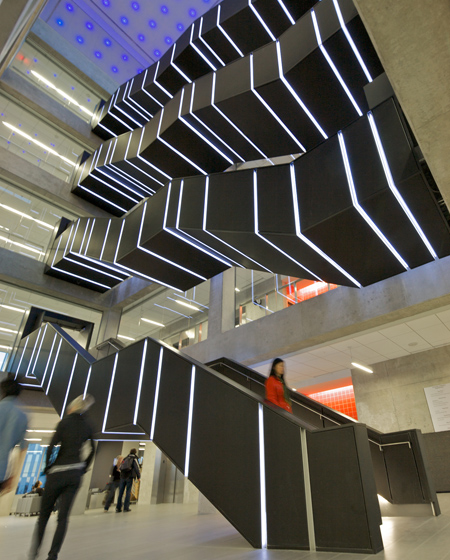
Architects have long had a love affair with stairs—from the elegant curves of Garnier’s Opera in Paris to the sleek floating glass of Apple stores. But the stairs in most multi-story buildings today are largely functional, emergency-use only environments which take a back seat to elevators for moving people between floors.
Active Design celebrates the stair, encouraging designers to make them visible, accessible, and integrated into a building’s primary circulation and orientation. By making stairs enjoyable, and giving them precedence over elevators or escalators, more people will use them. A 1997 study showed that men who climb 20-34 flights of stairs per week have a 20% lower risk of stroke or death from other cardiovascular causes.
stairs
[The Engineering Five Building at the University of Waterloo, by Perkins+Will]

An Urban Renaissance

A century ago cities were seen as unhealthy environments—dirty and disease-ridden. But today it is the active urban lifestyle that is proving to be the healthiest model.
If we design all our living environments to be more like stimulating, engaging, and diverse cities, then people will live longer, healthier lives. A 2004 study in Atlanta showed that men in more suburban, purely residential neighborhoods were on average 10 pounds heavier than the same demographic who lived in more urban, mixed-use areas.
Active Design might signal a strategic shift.
And New Yorkers have an average life expectancy 1.5 years longer than the rest of the country. At least part of that is attributable to New Yorkers walking more. And they walk because their environment is designed to encourage them to.

Conclusion

For now, Active Design is just a set of guidelines, not a ban on laziness. And although it has begun to influence building codes and zoning laws, Active Design currently has no real legal bite. Many of the smoking bans of the 1990s were enacted because companies and institutions feared that they would be sued over second hand smoke.
Second-hand obesity has yet to be recognized as a problem, and lawsuits against building owners for not making stairways more attractive are unlikely. But the principle of attacking a public health problem through changes to our environment—using design to change our lifestyle choices and using motivations other than doing it for our own good—is a compelling one.
Active Design isn’t a silver bullet to end obesity. But it just might signal a strategic shift that could help turn the obesity tide.

As both an urban designer and an architect, Jack L. Robbins brings a design-oriented approach and international perspective to solving complex urban design problems. Robbins has worked for nearly 20 years with public and private clients around the world, designing large scale master plans, campus plans and development frameworks, as well as residential and commercial high-rise buildings.
[Images from top: Jesslee Cuizon, Nicki Varkevisser, and Lisa Logan Architectural Photography]"

Fonte e imagens:
http://www.fastcodesign.com/1663272/this-is-why-you-re-fat

William H. Whyte

"William H. (Holly) Whyte (1917-1999) is considered the mentor for Project for Public Spaces, because of his seminal work in the study of human behavior in urban settings. While working with the New York City Planning Commission in 1969, Whyte began to wonder how newly planned city spaces were actually working out – something that no one had previously researched. This curiosity led to the Street Life Project, a pioneering study of pedestrian behavior and city dynamics.

PPS founder and president Fred Kent worked as one of Whyte's research assistants on the Street Life Project, conducting observations and film analyses of corporate plazas, urban streets, parks and other open spaces in New York City. When Kent founded PPS shortly thereafter, he based the organization largely on Whyte’s methods and findings. More than anything, Whyte believed in the perseverance and sanctity of public spaces. For him, small urban places are "priceless," and the city street is "the river of life...where we come together”. Whyte’s ideas are as relevant today as they were over 20 years ago, and perhaps even more so.

“Whyte’s work remains a living and usable handbook for improving our cities, our countryside, and our lives.” -- Nathan Glazer, Wilson Quarterly

“Holly always believed that the greatest lesson the city has to offer us is the idea that we are all in it together, for better or for worse, and we have to make it work.” -- Paul Goldberger, Architecture


Biography
Whyte was born in West Chester, Pennsylvania in 1917. He joined the staff of Fortune magazine in 1946, after graduating from Princeton University and serving in the Marine Corps. His book The Organization Man (1956), based on his articles about corporate culture and the suburban middle class, sold more than two million copies. Whyte then turned to the topics of sprawl and urban revitalization, and began a distinguished career as a sage of sane development and an advocate of cities.

In 1969 Whyte assisted the New York City Planning Commission in drafting a comprehensive plan for the city. Having been critically involved in the planning of new city spaces, he came to wonder how these spaces were actually working out. No one had researched this before. He applied for and received a grant to study the street life in New York and other cities in what became known as the Street Life Project. With a group of young research assistants, and camera and notebook in hand, he conducted pioneering studies on pedestrian behavior and breakthrough research on city dynamics.

All told, Whyte walked the city streets for more than 16 years. As unobtrusively as possible, he watched people and used time-lapse photography to chart the meanderings of pedestrians. What emerged through his intuitive analysis is an extremely human, often amusing view of what is staggeringly obvious about people's behavior in public spaces, but seemingly invisible to the inobservant.

The core of Whyte's work was predicated on the years he spent directly observing human beings, and he authored several texts about urban planning and design and human behavior in various urban spaces. Whyte served as an advisor to Laurence S. Rockefeller on environmental issues and as a key planning consultant for major U.S. cities, traveling and lecturing widely. He was a Distinguished Professor at Hunter College of the City University of New York. He was a trustee of the American Conservation Association, and was active in the Municipal Art Society, the Hudson River Valley Commission and President Lyndon B. Johnson's Task Force on Natural Beauty.


Perspectives
The Social Life of Public Spaces
Whyte wrote that the social life in public spaces contributes fundamentally to the quality of life of individuals and society. He suggested that we have a moral responsibility to create physical places that facilitate civic engagement and community interaction.

Bottom-Up Place Design
Whyte advocated for a new way of designing public spaces - one that was bottom-up, not top-down. Using his approach, design should start with a thorough understanding of the way people use spaces, and the way they would like to use spaces. Whyte noted that people vote with their feet – they use spaces that are easy to use, that are comfortable. They don’t use the spaces that are not.

The Power of Observation
Whyte suggested that through observation and by talking to people, we can learn a great deal about what people want in public spaces and can put this knowledge to work in creating places that shape livable communities. We should therefore enter spaces without theoretical or aesthetical biases, and “look hard, with a clean, clear mind, and then look again – and believe what you see.”


Quotable
“What attracts people most, it would appear, is other people.”

“One felicity leads to another. Good places tend to be all of a piece – and the reason can almost always be traced to a human being.”

“It is difficult to design a space that will not attract people. What is remarkable is how often this has been accomplished.”

“We are not hapless beings caught in the grip of forces we can do little about, and wholesale damnations of our society only lend a further mystique to organization. Organization has been made by man; it can be changed by man.”

“The street is the river of life of the city, the place where we come together, the pathway to the center.”

“If there's a lesson in streetwatching it is that people do like basics -- and as environments go, a street that is open to the sky and filled with people and life is a splendid place to be.”

“The human backside is a dimension architects seem to have forgotten.”

"Up to seven people per foot of walkway a minute is a nice bustle"

“There is a rash of studies underway designed to uncover the bad consequences of overcrowding. This is all very well as far as it goes, but it only goes in one direction. What about undercrowding? The researchers would be a lot more objective if they paid as much attention to the possible effects on people of relative isolation and lack of propinquity. Maybe some of those rats they study get lonely too.”

“So-called ‘undesirables’ are not the problem. It is the measures taken to combat them that is the problem…”

"I end then in praise of small spaces. The multiplier effect is tremendous. It is not just the number of people using them, but the larger number who pass by and enjoy them vicariously, or even the larger number who feel better about the city center for knowledge of them. For a city, such places are priceless, whatever the cost. They are built of a set of basics and they are right in front of our noses. If we will look.""

Fonte:
http://www.pps.org/info/placemakingtools/placemakers/wwhyte

Willian H. Whyte: The social life of small urban spaces

Jaime Lerner on Making Curitiba’s First Pedestrian Street

by Elizabeth Press on July 7, 2009

"This is the third installment of videos from Brazil. Demonstrating again how Curitiba Brazil was 35+ years in front of our NYC livable streets curve, this video is about a street transformation.

Former Mayor and founder of Bus Rapid Transit, Jaime Lerner sat down with me during my visit to discuss how and why he made the first pedestrian street in the middle of downtown Curitiba.

Rua XV de Novembro (15th of November Street) is a vital artery through downtown Curitiba. In 1972 under the direction of then Mayor Jaime Lerner, it became the first major pedestrian street in Brazil. The first phase of closing the street to automobiles and opening it to people took place in only 72 hours. The pedestrian plaza spans 15 blocks, and although it was initially unpopular, it is now a central meeting spot and the epicenter of local businesses in the center of Curitiba."


Fonte:
http://www.streetfilms.org/jaime-lerner-on-making-curitibas-first-pedestrian-street/